








Mergers & Acquisitions: How Marketing Strategies Enable a Smooth Transition
5 Key Challenges in M&A that Marketing Strategies Can Solve Top M&A Lessons: Companies that clearly communicate the purpose of the merger,...
6 min read


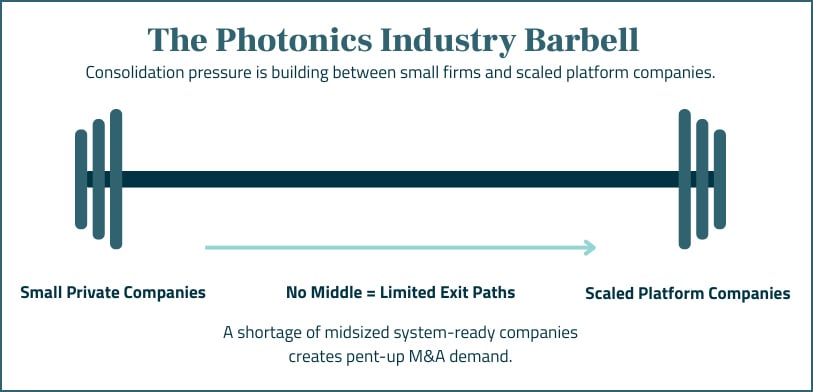
For photonics companies evaluating growth opportunities, understanding where demand is expanding—and how buyers are making purchasing decisions—is becoming just as important as advancing the underlying technology.
Photonics is growing as an industry for one simple reason: many emerging technologies require the speed and efficiency that only light-based systems can provide. It is now a foundational technology for:
Data and telecommunications already represent the largest segment of the market, accounting for nearly 28% of photonics revenue, while silicon-based photonic technologies continue gaining share as AI infrastructure scales. Overall, large-scale AI deployments are a major segment globally, accelerating demand for silicon photonics, PICs, and optical interconnects as datacenters reach the performance limits of traditional electrical systems.
Hyperscale data centers are rapidly adopting 800G and 1.6T optical interconnects to move massive amounts of data between GPUs. Industry analysts project that the AI-focused optical transceiver market alone will grow from $16.5 billion in 2025 to $26 billion in 2026, highlighting how central photonics has become to the future of AI computing.
At the same time, governments and commercial sectors are investing heavily in domestic semiconductor fabs, quantum technologies, and space programs, increasing the demand for specialized optical components and sensing technologies. The adoption of PICs in particular is growing, with the PIC market projected to grow from $20.85 billion in 2026 to $86.44 billion by 2034.
Beyond technology adoption, increasing export controls and tariffs are driving a shift toward regionalization, with governments and manufacturers prioritizing domestic sourcing strategies rather than purely offshore supply chains. As a result, photonics companies with manufacturing, engineering, or support capabilities positioned close to key end markets may gain competitive advantages in semiconductor, aerospace, defense, and advanced manufacturing applications.
| Driver | Growth Factors | Geography | Opportunity For… |
| AI Infrastructure & Datacenters |
Rapid deployment of AI training clusters, increasing bandwidth requirements, and the need to reduce power consumption and latency in hyperscale data centers |
North America, Europe, Asia Pacific | Silicon photonics, PICs, optical transceivers, optical packaging, test & measurement |
| Semiconductor Manufacturing Expansion |
Government-backed semiconductor initiatives, construction of domestic fabs, demand for smaller process nodes, advanced packaging, and increased reliance on optical metrology, inspection, and laser processing technologies. |
United States, Europe, India, Taiwan, South Korea, Japan | Optical metrology, inspection systems, lithography optics, laser processing |
| Photonic Integrated Circuits (PICs) |
AI infrastructure, expansion of 5G/6G networks, increasing data transmission requirements, adoption of silicon photonics, and investment in quantum computing and communication systems |
Asia Pacific, North America, Europe | Foundries, chip design, packaging, testing, silicon photonics |
| Quantum Technology Investments |
National quantum initiatives, demand for secure communications, and increasing deployment of PICs in quantum computing, sensing, and communications. Still mostly in R&D. |
U.S., Canada, Europe, U.K., China | Single-photon devices, PICs, detectors, optical communications, cryogenic optics |
| Commercial Space & Satellite Networks |
Increasing satellite deployments, changing SWaP-C requirements, and demand for optical communications and sensing systems. |
U.S., Europe, Middle East, Asia Pacific | Large and micro space optics, free-space optical communications, imaging systems, precision manufacturing |
| Autonomous Systems & LiDAR |
Increased advanced driver assistance systems (ADAS), autonomous vehicles, robotics, industrial automation, and real-time sensing requirements. |
China, North America, Europe | LiDAR, machine vision, detectors, laser sources, optical sensors |
| Healthcare & Medical Diagnostics |
Growth in minimally invasive procedures, increasing use of advanced imaging systems, expansion of point-of-care diagnostics, and demand for higher-precision diagnostic tools. Slow growth and cost-pressures in R&D. |
North America, Europe, Asia Pacific | Medical imaging, OCT, spectroscopy, precision optics, fiber optics |
As AI infrastructure scales, semiconductor investments accelerate, and emerging technologies such as quantum computing and commercial space mature, demand for photonic components and optical manufacturing capabilities will continue to expand. For photonics companies evaluating growth opportunities, the key question is now:
How do I position myself and my products to meet evolving demands of the photonics industry?
Looking to identify the highest-growth markets for your photonics technology?
Launch Team has spent 40 years helping photonics companies evaluate market opportunities and develop strategies that align technical capabilities with buyer demand. |
|
How you meet your buyers has changed significantly. Buyers complete almost 70% of their research before even reaching out, driven by younger demographics, digital platforms, and AI search engines. Decision-makers are increasingly turning to Google, ChatGPT, Gemini, Claude, industry forums, your website, and technical content to evaluate solutions before requesting a quote.
This shift has important implications for photonics companies. Buyers are searching for answers, not just product solutions. They want to understand which technologies can solve their challenges, reduce risk, improve performance, accelerate development timelines, or lower costs.
AI search is the primary tool being used now to research, which pulls from fresh, relevant web content, third-party publications, and social media platforms like YouTube, LinkedIn, and Reddit.
In our accounts in Q2, we saw that B2B tech organic search is estimated to take a 34-40% hit this year. Most of our accounts saw an overall uptick in traffic this quarter, some as much as 45%, by improving paid social targeting, increasing frequency of updates (76% of AI citations are to pages updated in last 30 days), and leveraging content in new ways to improve AI search.
When it comes to addressing this changed buyer journey, technical capability is rarely the primary obstacle. More commonly companies struggle to enter the market because they:
Lead with specifications instead of outcomes.
Use highly technical messaging that does not resonate with business decision-makers (or LLMs).
Attempt to serve too many industries simultaneously.
Lack application-specific content that demonstrates expertise.
Many organizations assume buyers understand the implications of a technical specification. In reality, most buyers want to understand how that specification affects performance, risk, cost, or time-to-market. The companies that grow fastest are often those that simplify complex technologies into clear business value through a structured market-entry strategy.
The goal should be to answer the buyers’ questions through your platforms long before they contact your sales team.
As buyers increasingly rely on digital research, AI-powered search, and application-specific expertise to evaluate suppliers, the companies that win will be those that align their technical innovation with clear positioning, targeted messaging, and a strong digital presence. Whether you're entering a new market, launching new technology, or looking to increase visibility among engineers and decision-makers, Launch Team helps photonics companies turn complex innovations into compelling growth strategies.
Ready to strengthen your positioning? Set up a free 30-minute strategy call to discuss your needs.


5 Key Challenges in M&A that Marketing Strategies Can Solve Top M&A Lessons: Companies that clearly communicate the purpose of the merger,...

Technology Doesn't Replace Great People. It Helps Them Scale Their Impact. Manufacturers have always competed on quality, delivery, engineering...

TL;DR AI is changing how buyers consume email. Subject lines, preview text, and relevance matter more than ever. Email performs best as part...