







6 Key Marketing Strategies for B2B Product Launches
Top 5 takeaways: Start with customer and market research to validate demand and uncover buyer needs. Position your product clearly and...
5 min read

|
Top 5 takeaways:
|
With over 40 years in the deep tech and industrial industries, we have seen many product launches, good and bad. But what makes a product launch a success?
It’s all about aligning your audiences, product positioning, sales enablement, and marketing strategies to generate leads. By doing this, our clients have seen meaningful growth, from a 400% increase in qualified leads in just 12 months to 364 new contacts from an integrated sales and marketing plan.
There is no one-size-fits-all plan to meet this goal, but in our experience, we have seen companies achieve success by implementing six key marketing strategies.
|
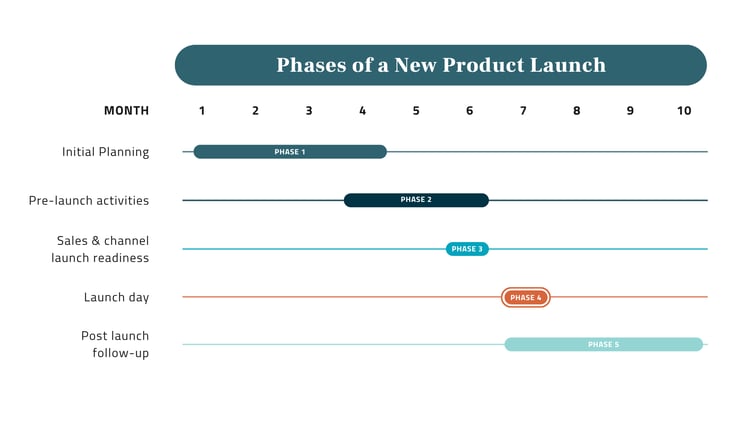
Phase 1: Initial Planning
|
One of the first (and most important) steps is knowing your audience. Often done during the initial planning phase, market research identifies where the demand is for your product. Be sure to conduct qualitative and quantitative research on market sizing, competitive landscape, and growth opportunities.
A crucial strategy is Voice of the Customer. This is when you either survey or interview your key customers to understand their experience of working with you, the impacts of your technology, and their decision criteria. These facts inform your strengths, any weaknesses, customer needs, and how to market your next innovation.
Consider asking the following questions:
|
Phase 1: Initial Planning
|
How does your audience view your company? Can they tell if content is from your brand without looking at your logo? Do they know what your differentiator is? Your market positioning and brand identity are invaluable in the digital era.
Your product positioning could be the differentiator in whether your launch succeeds or crashes.Ensure success with our proven positioning strategies. |
First, determine your market and product positioning. Effective positioning helps buyers understand why they need your solution and what sets it apart from your competitors. Use your market research, competitive landscape, and Voice of the Customer to tailor your positioning statement, messaging, and value proposition to your audience.
Then, determine your brand identity. Your brand identity is your story and promise to your customers. We have seen many companies discount the impact of branding, but if your differentiator and technology are not communicated clearly, you will lose deals before you even talk to a buyer. A new product brings the opportunity for a brand refresh that aligns sales, product development teams, and marketing on the same goal.
We have seen the right market positioning and brand identity lead to higher win rates, larger deal sizes, and higher trust with your audience.
|
Phase 2: Pre-launch Activities
|
Something we have seen get overlooked in launch planning is website strategy. In today’s landscape, your website is your most vital tool.
Across our work, we see that B2B buyers are using AI-powered search tools, such as ChatGPT or Claude, to research suppliers and vendors before ever talking to a representative, increasing “no-click” leads and AI referrals. A lot of those leads are coming straight from website updates. In Q2 2026, about 76% of AI citations were from pages updated within the previous 30 days.
However, once users get to your site, it must also be optimized for user experience (UX) and directly explain how your product will benefit the customer’s project. Engineers, procurement teams, and technical decision-makers expect to find specifications, capabilities, application information, and supporting content online.
Before the product launch, think through:
Remember, while prospects may eventually discover your solution through traditional search engines, AI platforms, industry publications, social media, and peer recommendations, a strong website strategy ensures your product can be found from the start.
|
Phase 2: Pre-launch Activities
|
Product launches are not a single-day event. You must build credibility in the application before the launch day. Publishing educational content, thought leadership, and teasers leading up to launch can help establish authority, improve discoverability, and create demand before buyers are actively evaluating solutions.
Take an omnichannel approach to content marketing. For deep tech and industrial companies, buyers often require multiple touchpoints before making a purchasing decision to build trust, address technical questions, and reduce perceived risks.
A successful product launch content strategy may include:
The key is to create content that focuses on customer outcomes rather than just the product features. Explain what problem your technology solves, the results customers can expect, and why your solution should be chosen over competitors.
|
Phase 3: Sales & channel launch readiness
|
In marketing, metrics are essential for measuring ROI and guiding strategy. The same principle applies to product launches. Without clearly defined key performance indicators (KPIs), it’s difficult to show whether a launch generated awareness, influenced buyers, or drove meaningful business results.
For deep tech and industrial companies, KPIs often extend beyond website traffic or social media engagement. Consider metrics that reflect buyer behavior, market awareness, and revenue generation, such as:
Establishing baseline measurements before launch ensures you can accurately assess performance during the campaign and afterwards. Review KPIs on a monthly and quarterly basis to identify what’s working, where buyers may be dropping off, and which activities deserve additional investment.
|
Phase 3: Sales & channel launch readiness
|
We are in the AI Transformation age.B2B companies must leverage and optimize their digital and AI toolset to align sales and marketing processes seamlessly. |
We know sales cycles are often longer and more complex in deep tech industries. The way B2B buyers interact has changed, with AI search engines and social media becoming the first line of contact. Customers expect seamless sales processes and tailored marketing across channels.
Setting up seamless sales and marketing automation processes can help keep up with lead follow-up, give your team better insight into revenue forecasts, and align sales and marketing goals.
Start with your goals, and personalize your workflows and tech stack to match. What actions should happen when a prospect engages with your launch campaign? Should they receive educational content? Be routed to a sales associate? Be entered in a nurturing sequence? Defining these workflows before launch helps ensure no opportunities are missed.
In this step, you should evaluate your CRM readiness. Before launch, verify that your CRM can track product-specific opportunities, campaign attribution, revenue sources, and customer interactions. Clean data and consistent reporting will allow you to accurately measure launch performance and forecast growth.
|
A successful product launch begins long before the official announcement and continues well after a news site publishes your press release. By combining market research, positioning, KPI development, sales and marketing automation, website readiness, and ongoing content marketing, B2B deep tech and industrial companies can create launch programs that drive awareness and generate qualified opportunities.
Need help navigating product launch planning? Launch Team has helped companies like yours create successful product launches for 40 years. Work with our marketing experts to meet your revenue targets.


Top 5 takeaways: Start with customer and market research to validate demand and uncover buyer needs. Position your product clearly and...

Updated 2026 FABTECH is North America’s largest metal forming, fabricating, welding, and finishing event—and offers a fascinating and forward-looking...

Updated October 2026 In Q2, companies were back in motion. In Q3, companies were focused on upgrading existing marketing and sales processes to meet...