







State of Industrial Automation 2026
Key Takeaways: Industrial automation in 2026 is driven by AI, IIoT, machine vision, robotics, and flexible automation. Labor shortages,...
6 min read
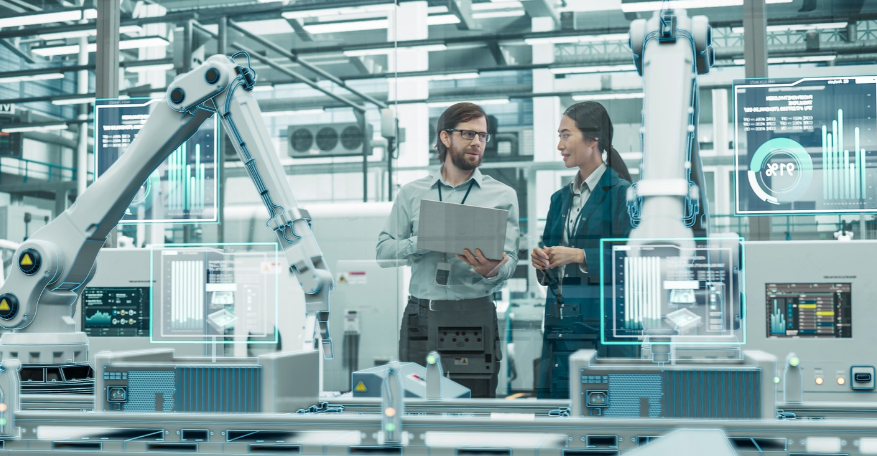
Industry 4.0 is underway, a period in the industrial market where automated technologies, artificial intelligence, cobots, data-driven technologies, and machine vision are digitizing shop floors.
While the skilled labor shortage was a catalyst for smart manufacturing, factories are now prioritizing the Industrial Internet of Things (IIoT), which allows seamless communication across the production floor, from machine to human to back-end data insights that predict maintenance needs, lead times, and ways to optimize efficiency.
Simply, Industry 4.0 revolutionizes how the industrial sector views manufacturing. And the future is automated.
Industrial Automation Market Drivers
The global industrial automation market size alone is expected to increase from
USD 238.4 billion in 2026 to USD 373.6 billion by 2032 at a CAGR of 7.82% from 2027 to 2032.
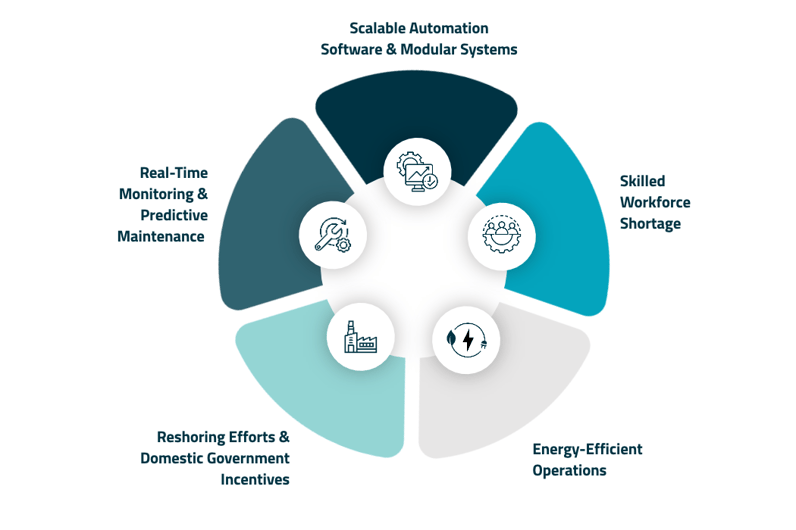
In 2026, 44.86% of the market share is focused on industrial control systems (ICS), reflecting the recent need for real-time monitoring on large-scale production floors.
However, the industry is shifting, with automation software being one of the fastest-growing segments, at a 10% CAGR between 2027 and 2032. At the same time, modular automation systems are winning over fixed automation; Mordor Intelligence forecasted the modular market to grow at a 13.8% CAGR. This highlights the demand for greater intelligence, data processing, and flexibility to scale up processes through digital transformation.
That digital transformation has become key to staying competitive in the market, and in Rockwell Automation’s smart manufacturing report, 90% of over 1,500 leaders in the market agree.
Whether you are trying to target new buyers or looking to exit your company, automation/AI and technology integration have become essential, decisive factors.

Job openings are increasing, but there is still a skilled workforce shortage as many key employees retire and younger generations stray away from traditional manufacturing jobs. Many manufacturing leaders are seeing this as an opportunity to invest in automation, such as cobots on the factory floor, to alleviate repetitive tasks, restructure roles on the factory floor, and reskill talent.
Rockwell Automation reports that leaders are using AI to augment rather than replace their people, with 50% of leaders repurposing existing workers into higher managerial and operational roles.
Energy-efficiency mandates and cost pressure are accelerating as AI infrastructures and the technology landscape continue to grow. Recent mandates, such as the United States motor standards and the European Union’s Ecodesign Regulation 2024/1781, have pushed manufacturers to adopt ways to decrease energy costs and reduce electricity use by 15-25%.
Many manufacturers are combating energy usage using smart IoT sensors, automated controls, and industrial AI for real-time monitoring and dynamic load-adjusting to optimize productivity while lowering energy waste.
Supply chain disruptions, geopolitical shifts, and reshoring efforts are encouraging manufacturers to expand domestic capacities, creating a new demand for automation to increase productivity while reducing energy use in localized facilities. Governmental facilities are supporting this effort, for example:
Breaking through the market noise requires in-depth technical information, proven data, and cross-channel visibility.Launch Team has partnered with industrial automation and smart manufacturing companies to increase B2B opportunities and meet overall growth objectives. |
While robotics and AI/ML are the market’s most visible segments, some of the strongest opportunities are emerging around machine vision, operational data, cybersecurity, and supply chain resilience.
|
Application |
Growth Factors |
Geography |
Opportunity For… |
|
AI-driven chip demand, new fab capacity, advanced packaging, smaller process nodes, and reshoring are increasing requirements for precise, automated production. |
U.S., Europe, China, Japan, Taiwan, South Korea |
Precision motion, machine vision, metrology, robotics, automated inspection, controls |
|
|
AI-Enabled Smart Manufacturing |
Move from isolated AI pilots to production-scale applications for process optimization, anomaly detection, operational data, quality control, scheduling, and decision support. |
North America, China, Germany, Japan, South Korea |
Industrial AI platforms, automation software, systems integrators, edge-computing providers, data-integration specialists |
|
Machine Vision & Automated Inspection |
Rising quality requirements, higher throughput speeds, skilled-inspector shortages, and advances in AI-based image analysis. Growth is concentrated in defect detection, traceability, and precise robotic guidance. |
North America, Europe, China, Japan, South Korea, Taiwan
|
Industrial camera manufacturers, optics and lighting suppliers, vision software developers, AI inspection companies, systems integrators |
|
Robotics, Cobots, & Flexible Automation |
Labor constraints, reshoring, rising labor costs, and demand for flexible production. The global stock of industrial robots reached 5 million units in 2025. |
China, U.S., Japan, South Korea, Germany, India |
Robot OEMs, cobot manufacturers, end-of-arm tooling providers, safety-system suppliers, robot programmers, integrators |
|
Warehouse & Logistics Automation |
E-commerce growth, faster fulfillment expectations, warehouse labor shortages, and demand for real-time visibility, largely in automated storage, retrieval, sorting, picking, and material movement. |
North America, China, Western Europe, Japan, South Korea, Middle East |
AMR and AGV manufacturers, warehouse execution software providers, machine-vision companies, sensor suppliers, conveyor and material-handling integrators |
|
Expanding pharmaceutical production, strict validation requirements, serialization, contamination control, and demand for high-precision assembly. |
U.S., Europe, India, China, Singapore, Switzerland, Ireland |
Precision-motion suppliers, vision-inspection providers, robotics companies, cleanroom serialization platforms |
|
|
Supply Chain Traceability & Component Verification |
Stronger visibility into component provenance, authenticity, quality, compliance, and supplier risk. |
North America, Europe, Israel, Japan, South Korea, Taiwan |
Vision-AI inspection, serialization providers, component-verification platforms, digital-thread software providers, supply-chain intelligence companies |
|
Aerospace & Defense Manufacturing |
Increased defense spending, domestic supply-chain priorities, autonomous systems, stricter component provenance requirements, and advanced sensing and electronics |
U.S., Europe, Israel, Japan, South Korea |
Precision manufacturing, machine vision, traceability, robotics, sensing, automated inspection |
|
With precision requirements increasing and shop floors digitizing, we have noticed a key theme across sales and marketing: trust.
Buyers and key stakeholders want to work with companies that can prove how a product will benefit their production and lead to long-term ROI. Key strategies that prioritize trust include:
Learn more about what B2B sales and marketing strategies are working across deep tech industries through our regularly updated quarterly trends: Industry Lookback & What to Prioritize This Quarter.

Mergers and acquisitions have increased due to pent-up demand in 2025. We see that buyers are paying for:
Industrial automation is becoming smarter, more connected, and, ultimately, more competitive. As technology transforms the factory floor, companies that clearly communicate their value and build buyer trust will be best positioned for growth.

Key Takeaways: Industrial automation in 2026 is driven by AI, IIoT, machine vision, robotics, and flexible automation. Labor shortages,...
Top 5 takeaways: Start with customer and market research to validate demand and uncover buyer needs. Position your product clearly and...
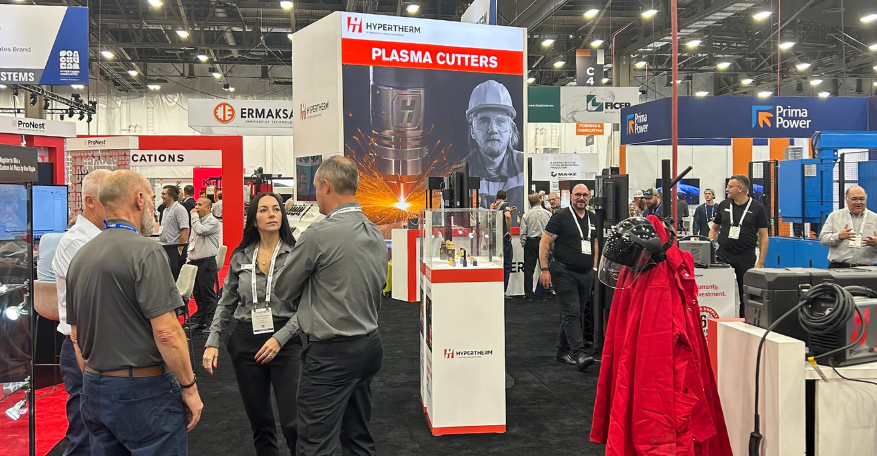
Updated 2026 FABTECH is North America’s largest metal forming, fabricating, welding, and finishing event—and offers a fascinating and forward-looking...